Saturday, October 19, 2013

Home Brew Beer at the Rivers Club


A delightful beer tasting took place last evening at the Rivers Club in Oxford Center. But unlike most tasting where the local or regional breweries have their beers on tap, this event was made up entirely of home brewers and the beer they made in their kitchens or basements. Well, Full Pint Brewery was the lone local brewer as well as South Hills Brewing Supply. All in all there were eight home brewers offering some exciting and different beers not usually found in your local pub.

I was a member of the Three Rivers Alliance of Serious Homebrewers since the founding in the early 1980’s (yes, I’m that old) and have seen the interest in home brewing grow over the years. Many home brewers brew beer that can compete with the professionals and it was evident last night.

Mark Minuto took first place in the voting with his Agave Wheat Ale. Made with the juice he obtained at Whole Foods, the drink was absolutely splendid: very clean and refreshing. One that I particularly enjoyed was Dom Tomino’s Cucumber Wheat. Very much like Mr. Minnuto’s this as well clean and refreshing. The cucumber taste was very present but delicate. Dom took the time to remove the outer skin to avoid giving the beer any bitterness. Both of these beers are in my “This is just a nice beer” category. Despite being a beer tasting, Terry Sasala brought an English Cider. From my exhaustive study ciders in England I have to say that the Queen would be pleased. Low in alcohol as most are, one would be able to enjoy several pints during the World Cup.

Still, for something different, Bob Bero brought his homemade B-Hoppy hard candy. He uses the hops after they are removed from the boil to make three types. Each of the three candies has a different type hop: Golden, Cascade and Saaz. The “anchor” brewer at the tasting was Full Pint with their Nut Brown Ale. This is not your father’s New Castle as it had a bit of smoky taste given it from the use of Rauch malt. Certainly not a Rauchbeir it had a delicate taste but your buds told you this was something different. This was a very well rounded menu of brews.  

This was the first Hoptoberfest at the Rivers Club and everyone hopes it will not be the last. The young professionals who were in attendance were sparse enough that everyone had plenty of time to chat with the brewers and one another. This was more of a meet-up and by far it was not a drink fest. Myself, I got to see some old friends that I have not seen in years making this somewhat of a reunion for me. This was a Rivers Club member’s only event (I was invited) but I would like to see it open to the public on a limited scale next year. Let’s keep our fingers crossed. Finally, cheers to all the brewers as they dedicated their time and home brew for this.

Local home brewers in attendance were:
Campbell Brothers Joint Effort Brewery, Brad Campbell
Homebrewer Mark V. Minuto
Homebrewer Dom Tomino
Homebrewer Tom Cocain
Pump House Homebrew Shop, Greg & Tammie Wormley
Irving’s Brewery, Tom Amundien
B-Hoppy the Original Candy, Bob Bero
Edgewater Brewery, Terry Sasala

Saturday, July 20, 2013

Brewers in Allegheny County 2013


How many breweries do we have in Allegheny County? The list may surprise you as a few are not doing business as an actual brewery-restaurant or so small they are off the radar. The following 15 breweries are currently licensed to brew beer in Allegheny County:

Brew Gentlemen (Braddock)
Copper Kettle (Greenfield)
Costar Brewing (East Liberty)
Draai Laag Brewing (Millvale) ***
East End Brewing (Larimer)
Gist House Brewing (Millvale) ***
Hofbrauhaus (South Side)
Hop Yard Brewing (Lawrenceville)
Iron City Brewing (Lawrenceville) Inactive
Lawrenceville Brewery (Church Brew Works) (Lawrenceville)
Penn Brewery, Pennsylvania Brewing Co. (North Side)
Pig Hill (North Side) makers of Kombucha
Rivertowne (Monroeville)
Roundabout (Lawrenceville)
Walnut Brewery (Rock Bottom) (Homestead)
*** Indicates brewery license as well as brewpub license holder.

Of these, Iron City is inactive and Grist House was still pending. In doing a search on July 18, 2013 I found it interesting that only two breweries actually had a brewpub license: Draai Laag and Grist House. I would like to think the LCB database is up to date but they still have the late Tom Pastorius as a member of Penn Brewery.

The following seven breweries are no longer operating:
Allegheny Brewery & Pub, Pennsylvania Brewing Co. (North Side)
Foundry Ale Works, Sweetwater Brewing Co. (Strip District)
John Harvard’s Ale House (Wilkins Township)
Milkman Brewing
Strip Brewery (Strip District)
Three Rivers Brewery (Strip District)
Valhalla (Strip District)

Actually, the Allegheny Brewery & Pub is still in business but took on the name Penn Brewery way back in the 1990’s. They are the only venue to change their name.

Milkman never started brewing and as of this date they have not received a license from the state.
I am sure that somebody may find a mistake on my part and will let me know. Please, keep the four letter words to a minimum.

Friday, April 12, 2013

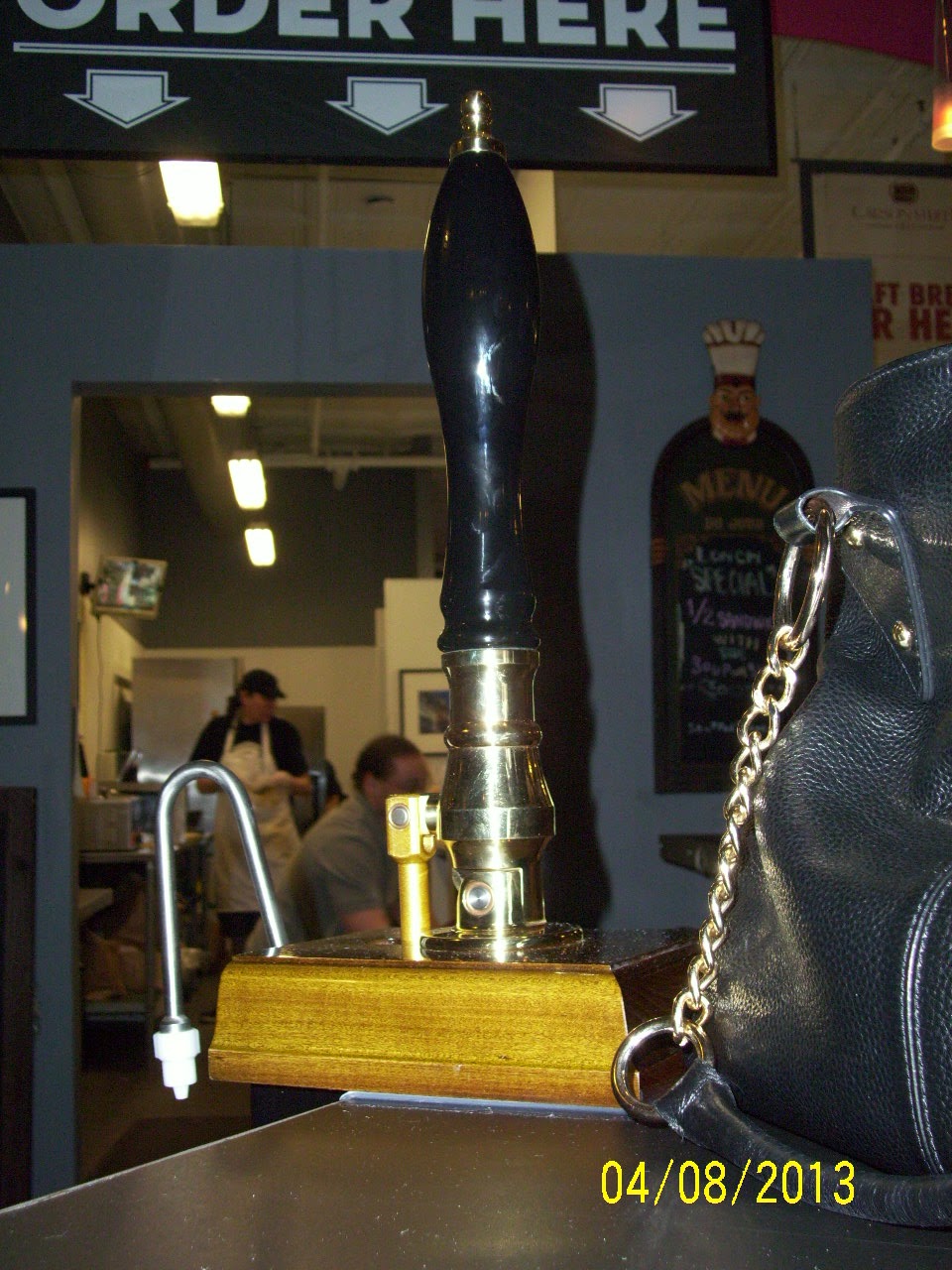
Carson Street Deli Beer Engine


Look what I found. South Side has a new real ale destination in the Carson Street Deli at 1507 E Carson St. One week before tax day Mike had a new beer engine installed and is now committed to serving real ale. For those that may not know, a beer engine is a hand operated vacuum device that draws beer from a cask under the bar or in a cellar. The beer is less carbonated than regular keg beer, which had been pressurized with added carbon dioxide gas. Cask beer enables the delicate aromas and finer textures to come through.

What is called real ale is well made beer that has no preservatives or chemicals to make it “better”. The brewer does that with clean water, young grain and fresh hops. The beer does ferment at the brewery as all beer does. But with real cask ale, the yeast is not filtered out of the beer but remains. The brewer adds priming sugar to the keg so that it under go’s a secondary fermentation on its way to the pub and in the pub’s cellar. This keeps the beer under a mild carbon dioxide blanket but does not over carbonate the beer. This is an excellent way to drink a craft beer.
Cheers to Mike.

Check the Deli’s tweets for updates on what’s coming through the engine.


Thursday, December 6, 2012

1913 Brewing in Allegheny County


The following companies were brewing within Allegheny County at the beginning of the 20th century. The Industrial Directory of the Commonwealth of Pennsylvania, Volume 1 lists businesses in the state for 1913 and the first book was published in 1914. The branch breweries were all indendant breweries when they were merged with trust companies.

This is not an in-depth look at the brewing history of Allegheny County at the time but rather a snap-shot of what we had before national prohibition practically wiped out an entire trade. For more on the brewing in Pittsburgh see my main site: Pittsburgh Brewers.

Anchor Brewing Co
Brackenridge

Independent Brewing Company
First National Bank Bldg., 23rd Floor, Pittsburgh
(Page having this listing was damaged)
The company had the following branch breweries in 1913:
American, Millvale (Allegheny County)
Anderton, Beaver Falls (Beaver County)
Butler, Negley Ave, Butler (Butler County)
Charleroi, 1st Street, Charleroi (Washington County)
Chartiers Valley, James & Chestnut, Carnegie (Allegheny County)
Duquesne, 22nd & Mary, Pittsburgh (Allegheny County)
First National, Thomas St, McKees Rocks
Globe, West St, Monongahela, (Washington County)
Hill Top, Southern Ave, Mt. Oliver (Allegheny County)
Homestead, 6th & West, Homestead (Allegheny County)
Loyalhanna, Jefferson & Harding, Latrobe, (Westmoreland County)
Lutz, Spring Garden Ave., Pittsburgh (Allegheny County)
Monessen, Monongahela Ave, Monessen, (Westmoreland County
New Kensington, 2nd & Lith St, New Kensington, (Westmoreland County)

Liberty Brewing Co.
Pittsburgh

Old Economy Brewing Co.
Fair Oaks

Pittsburgh Brewing Co.
1619 Oliver Bldg. Pittsburgh
No individual streets were given for the breweries.
The company had the following branch breweries in 1913:
Baeurlein (Allegheny County) $
Connellsville (Fayette County)
Eberhardt & Ober (Allegheny County) $
Iron City (Allegheny County) $
Jeanette (Westmoreland County)
Keystone (Allegheny County) $
Latrobe (Westmorland County)
McKessport (Allegheny County)
Mt. Pleasant (Westmoreland County)
Phoenix (Allegheny County) $
Straub (Allegheny County) $
Uniontown (Fayette County)
Wainwright (Allegheny County) $
Winter (Allegheny County) $

I found an ad for Pittsburgh Brewing in a 1907 American Federation of Labor booklet that listed only 8 of their breweries. The ad recommended these breweries as they were a union shop and the products sold were beer, ale and porter.
The 8 breweries are identified with the $ symbol. It is interesting to note that of the 9 breweries in Allegheny County, all but one of them were on the list.

Statistics
In 1913 there were 5 brewing companies in Allegheny County.
Three breweries were independent companies.
There were 2 brewing combine companies.
In Allegheny County alone there were 19 brewing facilities.

Independent Brewing had 14 branch breweries in the following counties.
Allegheny County, 7
Beaver County, 1
Butler County, 1
Washington County, 2
Westmoreland County, 3

Pittsburgh Brewing had 14 branch breweries in the following counties.
Allegheny County, 9
Fayette County, 2
Westmoreland County, 3Pittsburgh Brewers

Sunday, December 18, 2011

East End Brewery beer in London


When I was in London at the beginning of December of this year, I made it a point to have a pint of beer from the East End Brewery in Pittsburgh, Pa. The oddity of this is the fact that I am from Pittsburgh and drink the beers often, as the beers coming from Scott Smith's kettles are wonderful. So why would I travel to London at considerable cost to drink a beer I get down the street? Because it was there!

When I first started my travels to the land of fish and chips and pork pies I was not yet a beer drinker. Good thing too as there was not a lot of what we would call craft beer back in the 1970’s. As I got my training in good beer at Chiodo’s Tavern in Homestead I discovered that there was more than one beer style. Unfortunately nobody told London. I was drinking porter in Pittsburgh but no bartender in London ever heard of such a drink. “Do you have any porter?” “No, he went home early today”.

Finding good beer in London is pretty easy now. The Brits are finding that they can make interesting beers and so many are finding their way to London. European beers are as popular in the UK as they are here. American beers have been firmly planted on British soil and Sierra Nevada, Rough, Victory, Southern Tier and Duck Rabbit are as easy to come by as Young’s and Fullers.

Thanks to a rotating distribution system Scott was able to send 30 combined kegs of Black Strap Stout and Big Hop IPA to England and Europe. Two pubs in London had them on and the reviews that came back were positive. A long time buddy from London had a Black Strap and found it eye opening. One chap on twitter sent Scott a tweet with the word “blimey” in his review of the IPA. When a review incorporates the word blimey in it you have arrived. To stand next to a tap in a London pub sporting a beer from Pittsburgh is one that I am happy to stand next to. I support Pittsburgh brewers and will do so 4000 miles from home.

Photos are of the Craft Beer Company on Leather Lane, Clerkenwell EC1

Tuesday, December 13, 2011

Blue Barrels

The question was asked recently as to why the name barrel is abbreviated as bbl. There have been a few answers and I found a few more in the Internet as well. Some are almost right but a bit off the mark and some are just pure bunk.

It is widely believed that the abbreviation of barrel is bl and the bbl for blue barrels. Both of these are bunk. Yes, there were blue barrels but at the same time there were red barrels. Barrels (also known as casks) have been around for centuries and not until recently have they been standardized. Beer and wine barrels were standardized for a number of reasons. First and foremost that coopers (barrel makers) need a way to mass produce them. Although made by hand they cut staves to a uniform length so that the barrels would hold the same quantity of material. Beer barrels were made different that ale barrels so one produce could be distinguished from the other. This is where the blue barrels debut. It was not until western Pennsylvania became the oil capital of the world that color came to be applied. As the country was involved with a civil war, the northern government needed a way to tax oil to fund the war. It took some doing and industry basically came up with the standard size of 42 gallons. Thi sisze was in use during the 1700’s. Bunk 1: Standard Oil did not standardize the barrel, the industry as a whole did. Bunk 2: The barrel was not open topped and companies would not pay for spillage. Only an idiot would ship a valuable commodity this way. Bunk 3: A 42 gallon barrel was not used to guarantee anything to a buyer. It is just what the oil producers came to agree on.

Why was the barrel painted blue? Because it was not red. When the oil was refined there were a number of products derived. One was gasoline that nobody wanted. What did you need it for? It was also dangerous. The most important commodity derived from oil in the 1800’s was kerosene. This was the money maker for oil companies. As barrels were pretty much the same size (unlike beer and ale) another way was need to tell one from the other. Hence, kerosene was in blue painted barrels and gas was in red painted barrels. Even though kerosene was the more important product all barrels were still abbreviated bbl and not rbl. As shown in the link below, the abbreviation was used before the birth of “big oil” in 1859. Any further investigation will have to involve Ben Franklin.

See: http://sites.google.com/site/petroleumhistoryresources/Home/42-gallon-oil-barrel This story also tells of the birth of the Heisman Trophy.

Wednesday, December 7, 2011

South Side, Pittsburgh NID 1

Transparency and Disclosure

I have many issues with the SS NID and what they are attempting to market. They are supposed to be business owners so one would think they know how to sell. Yes, that was a purposeful dig by me. Their website is nice and green with warm and fuzzy fluff nut no real business plan. If they wish to sell me they need to answer some questions.

What do you want to do?

You want to clean sidewalks that owners are required to keep clean (by law) yet they refuse so you want my money to pay somebody else to clean it for them. Is that right? Many owners do clean their sidewalks. If you don’t like dirty walks then complain to the owners. If you take money to pay people to clean sidewalks, will everyone who pays have their walks cleaned? Will some not be? Will you keep an eye on my property at 2 AM when drunks are breaking mirrors and up-rooting plants? Who decides this?

What area does the NID propose to incorporate?

Before you can have a Neighborhood Improvement District you need to where it is. Do you have a map or descriptive outline of its boundaries? Will all properties within the area have to pay? Will all owners within the area get clean sidewalks and security? Will people outside the area have anything to say about this?

None of this is debatable. Tell me your plan and the area it encompasses. Put it on your website and facebook page and make it clear. If you want to get off to a good start (with me) do not call me a stakeholder. I am a citizen